
<!doctype html>
In This Article
Calculating possible child support amounts before starting your case can be a great way to understand what to expect during the legal process. This guide explores how child support works in Pennsylvania and provides steps to calculate an estimate. We also offer examples and answer questions about whether child support is based on gross or net income in Pennsylvania.
| Topic | Summary |
|---|---|
| Method | Income shares model: each parent contributes proportionally to combined net income. |
| Who pays | Typically the parent with less parenting time pays the basic obligation share to the other parent. |
| Key factors | Net income, number and ages of children, health insurance costs, child care, other support obligations. |
In Pennsylvania, child support is paid by one parent to the other parent. It is calculated using the “income shares” calculation, which measures the amount of parental income that would have gone toward the costs of raising a child if the parents still lived together. The concept ensures each parent’s share of their basic support obligation is proportional to their monthly net income.
The amount of support a parent provides is based on factors like:
A parent’s gross income may also be factored in for support purposes and include:
If one parent is collecting alimony, that amount may also be included in that parent’s gross income. “Net income,” as defined by the rules governing child support, does not always equate to a party’s take-home pay reflected on a pay stub.
Child support is mainly calculated using both parents’ net income. When a parent’s net income increases, their child’s reasonable needs may increase too. Under the rules of civil procedure, “net income” is based on a six-month average of a parent’s income and calculated by subtracting from gross income the following:
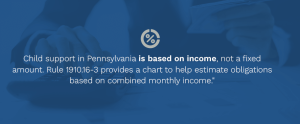
Because child support is specific to a parent’s income, there is no average child support amount. Parents’ combined net monthly income can range between various levels, from $1,100 to $30,000 or above. Pennsylvania Code Rule 1910.16-3 offers a basic child support schedule with these net income ranges to help parents understand their potential basic support obligations. We’ll explore how this chart works in the following section about calculating your child support responsibilities.
Here are the steps you can follow to estimate your potential child support payment:
Another option is to use the PA child support calculator provided by the Pennsylvania Child Support Program. It’s important to remember that this tool may only provide an estimate of your potential monthly child support amount. Working with a family attorney may help you determine a more accurate estimate based on unique factors about your situation and use strategies to help you settle a fair amount.
Considering the following scenario: Paul and Mary are divorced and have two children. Mary has primary custody of the children, but Paul claims both children as dependents on his tax returns.
Paul and Mary both work 40 hours per week and get paid bi-weekly. Paul earns $20 per hour, but his employer requires that he contribute at least 5% of each paycheck to his pension plan. Mary earns $17.50 per hour, but as part of a union must pay $43.75 per pay in dues. Each parent’s net income for support purposes would be as follows:
Paul
| Monthly Gross Income* | $3,466.67 |
| Taxes | -$406.30 |
| Mandatory Retirement | -$173.33 |
| Net Income for Support: | $2,887.04 |
Mary
| Monthly Gross Income* | $3,033.30 |
| Taxes | -$577.42 |
| Union Dues | -$94.79 |
| Net Income for Support: | $2,361.12 |
*Monthly Gross Income is calculated by the following formula $20 x 80 hours x 26 pay periods / 12 months.
Both parents’ net incomes, added together, total $5,248.16. Looking at the chart, their monthly basic child support obligation is $1,436.00.
Because Paul is the obligor, his monthly net income is divided by the total of the parties’ monthly net incomes to determine what percentage of the basic support amount he would pay.
$2,887 divided by $5,248.16 is 55.01%. 55.01% of $1,436.00 is $789.94. Therefore, Paul’s basic child support obligation is $789.94.
The basic child support obligation can be adjusted based on several factors such as health insurance premiums, childcare, and/or private school tuition. Those expenses can be allocated between the parents in proportion to their respective shares of the child support obligation.
In the example above, Paul’s income accounts for 55.01% of the basic child support obligation, while Mary’s income accounts for 44.99% of the basic child support obligation. If one of the children was in daycare which cost $500 per month, then Paul would be responsible for $275.05 of that cost, while Mary would be responsible for $224.95 of the cost. If Paul were paying the entire $500 directly to the childcare provider, then his support obligation would be reduced to account for Mary’s share.
In addition to adjusting the basic child support obligation for health insurance premiums, childcare and/or private school tuition, the court may consider the mortgage on the marital residence, the custody arrangement, and the support obligation to any child not a part of the current situation.
While these can result in an adjustment to the basic child support obligation, the court will also, at times, hear arguments on reasons to deviate from the calculation. However, any basis for deviation is very fact specific.
Do you need help ensuring a fair child support amount? Johnson Duffie is a law firm that has assisted clients in various practice areas for decades. Our family law and child support attorneys help parents determine a fair amount in their cases according to Pennsylvania’s child support guidelines.
A central benefit of working with Johnson Duffie attorneys is that we pay attention to your unique circumstances and try to work for a child support result that reflects your needs. Legal representation from knowledgeable professionals may help you achieve an agreeable outcome.
We guide you through every step of the process with the goal of settling your case in a fair manner. We may also assist you in gathering the correct financial information and documentation. To protect your rights, we also offer assistance in child custody, divorce, pre-nuptial and post-nuptial agreements and adoption.

If you are thinking about filing for support, or a complaint for support has been filed against you, it is important to understand the procedure followed and what factors domestic relations will consider when calculating support.
A skilled family attorney can answer these questions and advocate on your behalf, whether at a conference or at a hearing. The attorneys at Johnson Duffie are experienced in handling support matters at all stages of the proceeding.